
ESG consulting
Consulting services and advice to help you manage Environmental, Social and Governance (ESG) considerations, risks and opportunities.
No Content Set
Exception:
Website.Models.ViewModels.Components.General.Banners.BannerComponentVm

Our sustainability experts, Andrew Tasker and Tanya Lloyd Jones, review the key elements of the consultations, their potential implications for businesses, and offer practical recommendations to navigate UK sustainability reporting.
On 25th June 2025, the UK Government published three consultations on the future outlook of UK sustainability reporting:
The consultations on these new standards are open until 17th September with a view to being implemented in autumn 2025.

The new publications include drafts of “UK SRS S1” and “UK SRS S2,” which correspond to the IFRS S1 (General Requirements for Sustainability Disclosure) and IFRS S2 (Climate Related Disclosures).
Reporting under UK SRS is expected to become mandatory for UK-listed companies through rules set by the Financial Conduct Authority (FCA) once the standard is adopted as UK law or regulations. We assume this will be phased to other non-listed organisations in line with other reporting requirements such as TCFD (Task Force on Climate-related Financial Disclosures).
In summary, organisations must:
Foundations of compliant disclosure:
Companies will need to disclose against the following categories which are aligned with existing reporting requirements such as TCFD:
Timelines:
The UK government is consulting on how best to introduce mandatory climate-related transition plan requirements for UK-regulated financial institutions (including banks, asset managers, pension funds, insurers) and FTSE 100 companies.
The transition plans are intended to demonstrate how organisations will align their business strategies and operations with the 1.5°C goal of the Paris Agreement, showing credible, decision-useful information on their pathway to net zero.
The consultation explores different implementation routes and options to ensure that the requirements are effective yet proportionate, balancing transparency and regulatory burden.
The government seeks views on the scope of companies to be covered, the content and structure of transition plans, governance and accountability mechanisms, and how progress is reported.
In summary, companies subject to these requirements would need to:

The UK government consultation on assurance of sustainability reporting focuses on establishing a regulatory framework for third-party assurance providers who verify sustainability-related financial disclosures. Key points include:
In summary, companies and assurance providers would be subject to a more structured and regulated assurance process for sustainability disclosures, underpinned by oversight from a new or existing regulatory authority.
Whilst compliance requirements may be voluntary at first and phased mandatory requirements thereafter, the wider strategic benefits to sustainability reporting are well documented, such as improved risk management, operational efficiencies, public, customer and investor image, and access to sustainability-linked finance. Sustainability management and reporting should therefore remain a priority for companies. Our key recommendations are below.
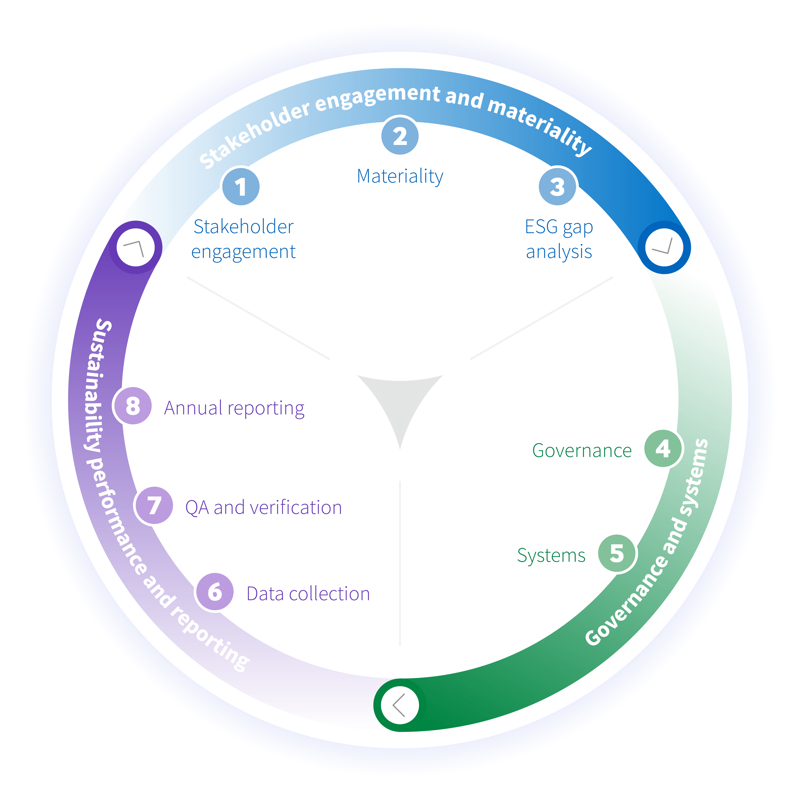
We can integrate specific ESG reporting needs into existing or new sustainability strategies using our framework to the right, assisting from initial trend analysis to implementation, assurance and reporting.
Our services

Associate Director - EIA & Sustainability