Clean air and new homes: A balancing act for the UK Government’s housing targets
Jinho Looi, Air Quality Consultant, explores the effects of the UK Government’s ambitious housing targets on air quality and shares steps for mitigation.
Jinho Looi
UK housing targets
In a press release first published in July 2024, the Secretary of State for Housing, Communities and Local Government announced a new plan to “overhaul the planning system to fix the foundations and grow the economy”[1]. As part of this overhaul, all councils in England are to be given mandatory housing targets to address the housing crisis.
The Deputy Prime Minister has written to every council Leader and Chief Executive in England to urge them to produce up-to-date local plans through which communities have a say in the building of homes and infrastructure. The end goal of these reforms is to deliver 1.5 million homes over the next five years[1].
So, what are the major difficulties that come with these new targets and how does air quality come into play?
Land availability and the use of Green Belt land
To meet the housebuilding targets, the Deputy Prime Minister has advised that the first port of call for development should be brownfield land. However, if required, green belt land should also be reviewed with an aim to identify ‘grey belt’ land. ‘Grey belt’ land is considered to comprise low-quality green belt land and is defined as “land of the edge of existing settlements or roads, and with little aesthetic or environmental value”. That being said, the government have stated that it will be up to individual councils to decide what will be designated as ‘grey belt’.
Despite the rising demand for new housing, building on green belt land remains controversial. Since its initial introduction over 70 years ago to limit the growth of large built-up areas and prevent towns merging into one another, numerous green belts have been established across the country around urban cores. Proponents of the green belt praise the natural landscapes, enhanced environmental quality, cleaner air and water, amongst many other benefits.
Notwithstanding this, there may be brownfield sites within the Green Belt. Some of these may have been airfields, old hospitals or research establishments. These sites could have their designation changed to grey belt and be developed without causing lasting damage to the wildlife. Supporters of the Green Belt argue that the focus should be on protecting and enhancing the degraded sections of the Green Belt rather than building on it[2],[3].
Air quality impacts
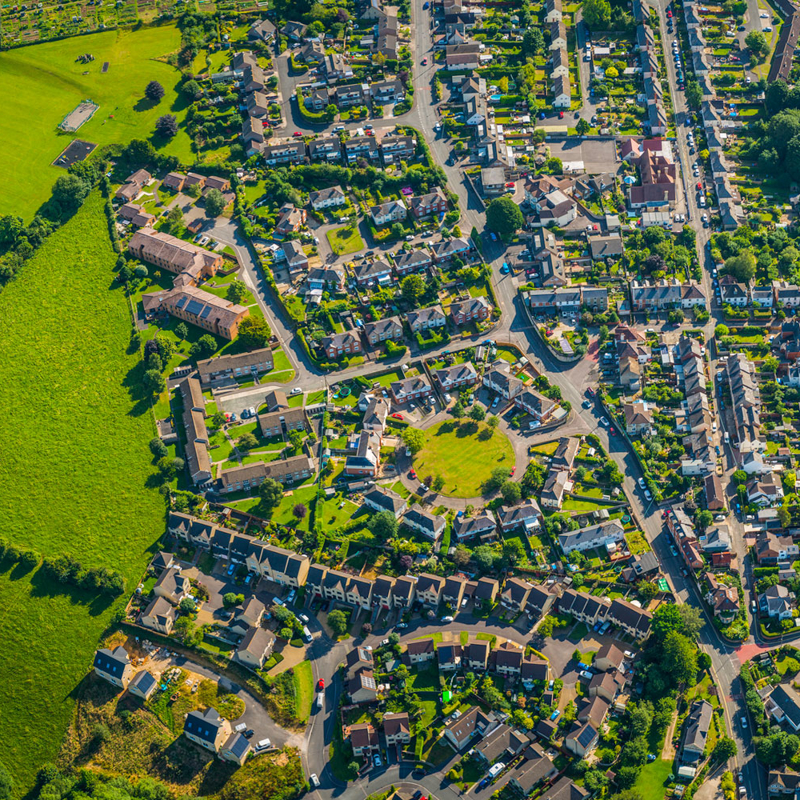
A challenge associated with such a large housing target is the potential effects on air quality. The World Health Organisation (WHO) have published global air quality guideline levels that consider the latest body of evidence on the health impacts of different air pollutants[4]. Currently, the government’s Air Quality Standards Regulations and Environmental Targets (Fine Particulate Matter) Regulations[5] include standards and limits for pollutant concentrations above the WHO guidelines. With the creation of 1.5 million new homes comes the risk of poorer air quality and possible exceedances of current air quality standards for both existing populations and new residents.
With the construction of the new homes, the associated major source of pollution will be road traffic exhaust emissions which commonly emit nitrogen oxides (NOx) and fine particulate matter (PM10 and PM2.5). This is especially true of developments that are not well-integrated or connected with public transport infrastructure. These pollutants may have potential impacts on sensitive receptors in the wider area, including those within Air Quality Management Areas (AQMAs) and ecologically important habitat sites. In AQMAs, where air quality objectives are unlikely to be met, additional traffic, even from sites not located within the AQMA, may further increase pollution concentrations and subsequently increase health risks to receptors within the AQMA. Similarly, designated habitat sites that support sensitive flora and fauna are potentially susceptible to the effects of traffic exhaust emissions which can lead to changes in the species composition and reduce species richness.
Increased energy demand will have an impact of energy usage. If this energy is derived from fossil fuels, there will be increased emissions of greenhouse gases and other pollutants. Some residents may also opt for gas boilers and fireplaces which will also emit pollutants, such as fine particulate matter, detrimental to health and the local environment.
Similarly, during the construction of the homes, exhaust emissions from construction-related vehicles (e.g. contractors’ vehicles and Heavy Goods Vehicles (HGVs), diggers, and other diesel-powered vehicles) have the possibility of generating significant levels of pollutants – this is especially true of larger developments or developments with shorter construction periods. Additionally, the deposition of dust on property and the health-impacts of suspended dust during demolition and construction may also pose significant risks to existing receptors such as nearby residential properties, hospitals, and care homes.
How can these issues be mitigated?
Given the large quantity of houses that will be required to meet the government’s ambitious targets, it will be important for house builders and local authorities to work together to ensure that exposure to pollutants is kept to a minimum. For example, house builders may opt to implement mitigation measures to reduce the air quality footprint of their developments. The Institute of Air Quality Management (IAQM) Position Statement on mitigation of air quality impacts[6] recommends the use of a mitigation hierarchy that prioritises prevention, then reduction and minimisation of exposure and impacts, and finally offsetting by proportionately contributing to air quality improvements. For more information on air quality mitigation options, take a look at our Air Quality Mitigation Wall Chart.
One of the most effective ways to reduce future emissions from a development is through careful consideration of the layout during the design phase. Notably, consideration should be given to the layout of the a new site and where future receptors will be in the context of existing sources of pollution (e.g. heavily trafficked roads).This approach is emphasised in Department for Environment Food & Rural Affairs’ (Defra) ‘PM2.5 Targets: Interim Planning Guidance’[7] that recommends “appropriate mitigation measures are implemented from the design stage, streamlining the process for planning and ensuring the minimum amount of pollution is emitted and that exposure is minimised.” Learn more about the implications of this guidance for new developments in our article here: Environment Act Particulate Matter targets: Interim planning guidance.
How we can help
Regardless of whether mitigation is considered or not during the design phase of a development, the environmental health departments of local authorities will likely still expect Air Quality Assessments to be produced for all new developments where there is the potential for negative impacts and effects.
At RPS, we can support you in providing air quality assessments for new residential developments. As experts in mitigation, we robustly calculate site-specific commitments and advise clients on proportionate Section 106 requirements. Whether your development is residential, commercial, or industrial-focused, we’re here to help you reduce your emissions and ensure compliance throughout the planning or permitting process.
References
[1] Housing targets increased to get Britain building again, Ministry of Housing, Communities and Local Government and The Rt Hon Angela Rayner MP
[2] Friends of the Earth (2024). Should we build houses on the green belt? | Friends of the Earth. [online] Friends of the Earth. Available at: https://friendsoftheearth.uk/nature/should-we-build-houses-green-belt.
[3] Wray, I. (2023). All You Need to Know about the Green Belt. [online] CPRE. Available at: https://www.cpre.org.uk/explainer/all-you-need-to-know-about-the-green-belt/.
[4] World Health Organisation. (2021). WHO global air quality guidelines. Available at: https://iris.who.int/bitstream/handle/10665/345329/9789240034228-eng.pdf
[5] Legislation.gov.uk. (2022). The Environmental Targets (Fine Particulate Matter) (England) Regulations 2022. [online] Available at: https://www.legislation.gov.uk/ukdsi/2022/9780348242959.
[6] Institute of Air Quality Management. (2018). Mitigation of Development Air Quality Impacts. Available at: https://iaqm.co.uk/text/position_statements/mitigation_of_development.pdf [Accessed 5 Aug. 2025].
[7] Department for Environment, Food & Rural Affairs. (2023). PM2.5 Targets: Interim Planning Guidance- Defra, UK. [online] Available at: https://uk-air.defra.gov.uk/pm25targets/planning.