
£ 97 m
project value
No Content Set
Exception:
Website.Models.ViewModels.Components.General.Banners.BannerComponentVm
Services
Technical services and consulting solutions for clients in the property, energy, transport, water, resources, defence and government sectors.
Advisory and management consulting
Communications, creative and digital
Design and development
Environment
Oceans and coastal
Planning and approvals
Project and program management
Water services
Advisory and management consulting
RPS advisory and management consulting services for businesses and projects, including economics, due diligence, transaction advisory, ESG and more.
Communications, creative and digital
Communications, creative and digital solutions for governments and businesses including community engagement, design, research, data and software development.
Design and development
Technical and consulting services for buildings, infrastructure and cities including architecture, engineering, surveying, landscape architecture and urban design.
Environment
Environmental consulting solutions for responsible, resilient and sustainable development including impact assessment, ecology and contamination management.
Oceans and coastal
RPS technical solutions for marine infrastructure and offshore development including coastal engineering, marine biology metocean science, and emergency response.
Planning and approvals
Development strategy, planning and approval solutions for buildings, infrastructure, transport and city projects and investments.
Project and program management
Project management solutions for the most complex building, infrastructure, organisational change, and systems projects.
Water services
Solutions for the water sector including quality monitoring, modelling, infrastructure design, engineering and asset management.
Sectors
World-leading technical and consulting solutions for clients in the property, energy, transport, resources, water, defence and government sectors.
Property
Energy
Transport
Defence and government services
Water
Resources
Property
Design, technical and advisory services for the property sector, including residential, commercial, retail, industrial, health, education and data centre projects.
Energy
Energy exploration, development and optimisation solutions for renewables, power and gas networks, energy storage, oil and gas and nuclear facilties.
Transport
Smart, safe and sustainable transport infrastructure development services and advice for rail, aviation, port and road clients and projects.
Defence and government services
Expertise for defence capability and infrastructure investments, security and safety projects, and information and telecommunications initatives.
Water
Discover our industry-leading strategy, design and management solutions for wastewater, groundwater, flooding, drainage and network infrastructure.
Resources
Commercial data, design advice and technical management solutions for safe and environmentally responsible resource exploration and operations.
Careers
Discover why RPS is a great place to build a great career
Careers in Australia and New Zealand
Careers in Australia and New Zealand
At RPS, every role provides an opportunity for you to grow your career within a collaborative, ideas-driven, and supportive culture.
Technical services and consulting solutions for clients in the property, energy, transport, water, resources, defence and government sectors.
Advisory and management consulting
Communications, creative and digital
RPS advisory and management consulting services for businesses and projects, including economics, due diligence, transaction advisory, ESG and more.
Project investment and finance
Business strategy and improvement
Explore Advisory and management consultingCommunications, creative and digital solutions for governments and businesses including community engagement, design, research, data and software development.
Creative, visualisation and immersive design
Data management, analytics and insights
Software design and implementation
Explore Communications, creative and digitalTechnical and consulting services for buildings, infrastructure and cities including architecture, engineering, surveying, landscape architecture and urban design.
Environmental consulting solutions for responsible, resilient and sustainable development including impact assessment, ecology and contamination management.
Contaminated land and remediation
Environmental Impact Assessment
Environmental permitting and compliance
Sustainability and climate resilience
Explore EnvironmentRPS technical solutions for marine infrastructure and offshore development including coastal engineering, marine biology metocean science, and emergency response.
Commercial fisheries advice and services
Marine site investigation and geoscience
24/7 response modelling and support services
Marine life mitigation - PSOs, MMOs and PAM
Metocean, Science and Technology
Explore Oceans and coastalDevelopment strategy, planning and approval solutions for buildings, infrastructure, transport and city projects and investments.
Project management solutions for the most complex building, infrastructure, organisational change, and systems projects.
Cost management / quantity surveying
Explore Project and program managementSolutions for the water sector including quality monitoring, modelling, infrastructure design, engineering and asset management.
Water quality modelling and monitoring
Explore Water services
World-leading technical and consulting solutions for clients in the property, energy, transport, resources, water, defence and government sectors.
Design, technical and advisory services for the property sector, including residential, commercial, retail, industrial, health, education and data centre projects.
Energy exploration, development and optimisation solutions for renewables, power and gas networks, energy storage, oil and gas and nuclear facilties.
Smart, safe and sustainable transport infrastructure development services and advice for rail, aviation, port and road clients and projects.
Expertise for defence capability and infrastructure investments, security and safety projects, and information and telecommunications initatives.
Organisational strategy and change
Explore Defence and government servicesDiscover our industry-leading strategy, design and management solutions for wastewater, groundwater, flooding, drainage and network infrastructure.
Commercial data, design advice and technical management solutions for safe and environmentally responsible resource exploration and operations.
We define, design and manage projects that create shared value to a complex, urbanising and resource-scarce world.
Brilliant minds finding solutions to complex problems, made easy to understand. Making complex easy.

We provided a multi-disciplinary service including fire engineering advice and liaised with the statutory authorities to gain regulatory approval for the work.
The Titanic Belfast development was a major factor in the regeneration of Belfast’s Titanic Quarter and the revitalisation of the area’s heritage.
The building includes an arts centre, conferencing facilities, a theatre and restaurants but more importantly houses the Titanic Experience Museum.
Project name
Titanic building, Belfast
Client
Titanic Quarter Ltd
Location
Belfast, Northern Ireland
Services provided
The building created several challenges that we had to overcome during both the design and construction of the works, including:
The building also presented various fire safety challenges as standard fire safety guidance couldn't be applied or allow for cost-effective design solutions due to the innovative nature of the architectural design. This included keeping stair sizes to a minimum to maximise the lettable floor area for exhibits and retail outlets.
The central atrium space is a focal point in the building and acts as a primary circulation space on the journey through the building. The atrium space is heavily occupied and forms part of the escape route from the building. Standard fire safety approaches wouldn't have permitted the atrium in its original proposed form, so we used fire engineering to justify its inclusion in the building design.
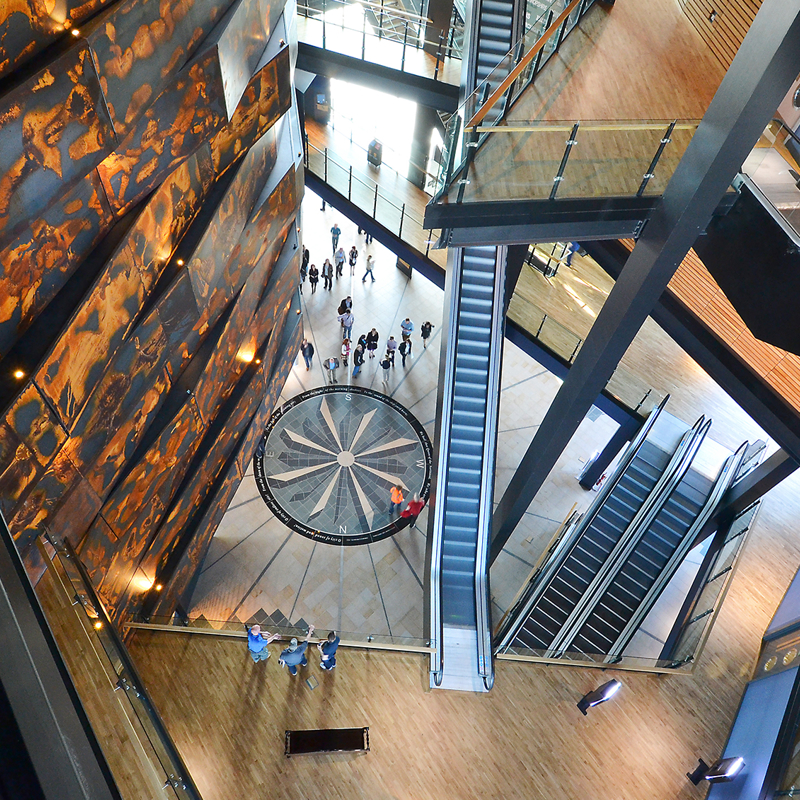
The upper ground level slab was designed to be a plaza for the public and emergency vehicles. The basement was an 1100mm dp flat slab supported on piles.
We produced a detailed National Building Specification (NBS) and method statements to ensure the concrete grade, cement content, w/c ratio and curing of the concrete were all addressed to ensure a good quality of concrete was achieved.
The superstructure comprised a steel frame with composite concrete beams and floors. The staircases provided stability, constructed in slip-form reinforced concrete. The cladding and glazing were fixed to the main frame with secondary steelwork. The ‘inverted’ structure (i.e., with floors getting larger as the height increased) meant that the stability of the frame was paramount. In some areas, steel columns had to be fabricated to suit both the aesthetics and as standard section sizes weren't available to span the unrestrained heights required.
A detailed fire strategy report was prepared for the development and the approving authorities throughout the design development stages of the project.
We undertook Advanced Computational Fluid Dynamics (CFD) modelling to demonstrate that the visitors in the building would remain safe in the event of a fire, particularly within the central atrium space. Given the building's complex geometry, CFD modelling offered the only realistic technical approach to assessing in detail the development and growth of fire and the spread of smoke throughout the space.
We used the CFD model to assess the tenability conditions that residents in the atrium may be exposed to based on a range of agreed fire scenarios, and we determined that they would remain safe during a building emergency evacuation. The outcome was an award-winning building that retains the architect’s aspirations for a vibrant atrium space.
£ 97 m
project value
14000 m2
of accommodation across 7 floors
520
car parking spaces

Technical Director - Structural and Fire Engineering