6.2 km
of Type 3 single carriageway and pedestrian/cycle facilities
No Content Set
Exception:
Website.Models.ViewModels.Components.General.Banners.BannerComponentVm


The overall scheme includes the following:
Project name: Killaloe Bypass, Shannon Bridge Crossing & R494 Improvement Scheme
Client: Clare County Council
Location: Co. Clare, Ireland
Services provided:
A number of environmental mitigations were put in place before the scheme proceeded to construction stage. They include the erection of bat boxes in trees adjacent to the route. A compensatory bat house was also built more than six months in advance of the site clearance works, which were undertaken during the winter months.
The detail design of the Shannon Bridge was optimised in comparison to the conceptual design. This involved removing high-maintenance components such as bearings and post-tensioning and making the structure integral at all intermediate piers. We also changed from a 800mm deep concrete deck to a 200mm deep slab supported by a steel composite ladder deck. This resulted in a significant reduction in embodied carbon. All structural concrete on the scheme was specified with 50% clinker replacement, exceeding the minimum requirement of 30% and further reducing the embodied carbon.
An innovative solution was adopted to mitigate against the discovery of underlain peat on the western approach to the Shannon Bridge, with the deletion of a carbon intensive piled slab and replacement with a low carbon alternative involving a green vegetated reinforced soil steepened slope to limit the footprint of the embankment over the peat, allowing a conventional foundation.
An 18th century heritage masonry arch bridge has linked the twin-towns of Killaloe and Ballina for centuries. However, the existing bridge is extremely narrow and for the last number of years it has been operated under stop-go traffic light control, leading to severe traffic congestion and conflict with pedestrians and vulnerable road users. Under this scheme, a new bridge linking the towns has been built across the River Shannon, with two traffic lanes and pedestrian/cyclist facilities on both sides. The project also includes a new bypass of Killaloe town and improvements to the regional R494 road which connects Ballina with the M7 motorway.
The River Shannon is a Special Area of Conservation (SAC) and the associated environmental constraints and sensitivities led to numerous challenges for the construction of a new bridge across the river. Planning conditions which mandated the addition of an extra span onto the bridge, combined with changes to bridge design standards since the grant of planning permission meant that the design team had to work hard to maintain the aesthetic concept of the original design.
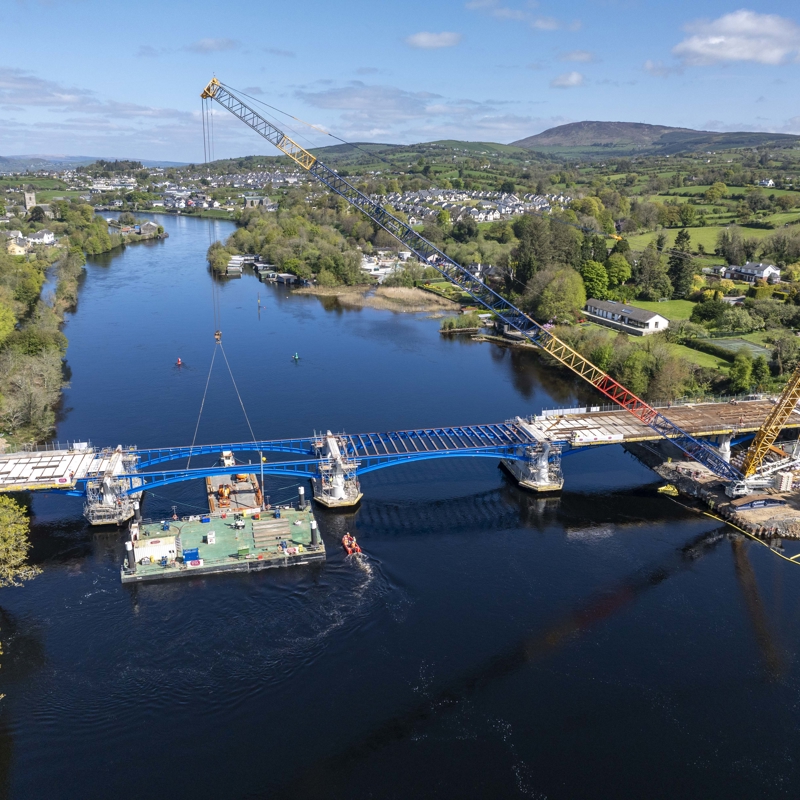
We developed a construction methodology to minimise in-river works and disruption to the fish-sensitive riverbed, designing precast concrete pile cap “bath tub” shells, and innovative steel support collars that supported the shells from the steel pile casings, without needing external support. This in turn allowed work to be undertaken in a safe dry environment.
Installation of the steel arched trusses was undertaken by crane from the river banks. Given the length of the lifting radius, the lift required a 600 tonne crawler crane, the largest in the country, with a boom length of over 100m and super-lift ballast of 400 tonnes.
The project is expected to lead to a 45% reduction in congestion and encourage tourism to the area which sits in a unique and scenic location at the mouth of Lough Derg. It also improves connectivity to the local railway station in nearby Birdhill, offering a sustainable transport option to locals and visitors alike.
6.2 km
of Type 3 single carriageway and pedestrian/cycle facilities
207 m
overall length of the Shannon Bridge's six spans
45 %
expected reduction in congestion
600 tonnes
capacity of crawler crane used to lift steel superstructure