Why data matters in the race for offshore wind
28 June 2023
Anna Crameri
No Content Set
Exception:
Website.Models.ViewModels.Components.General.Banners.BannerComponentVm

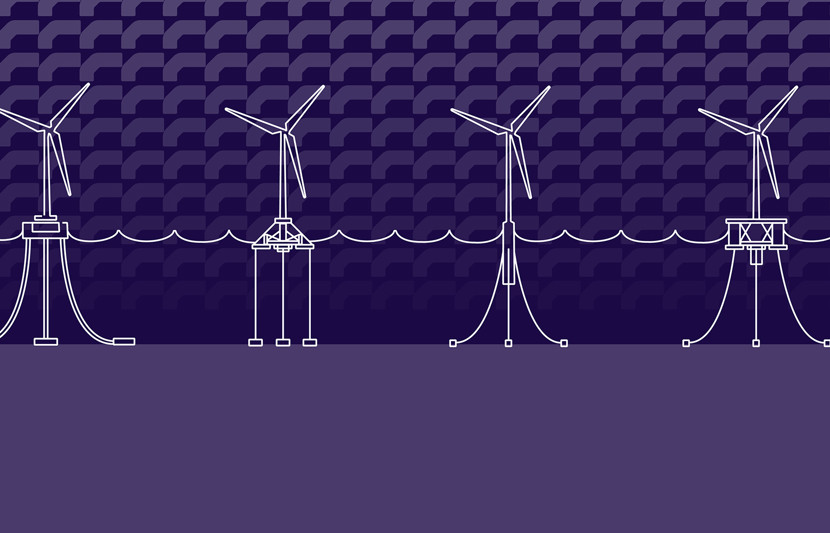
If you see an image of an offshore wind farm, chances are the turbines’ foundations will be fixed to the ocean floor. Most offshore wind farms in operation throughout the world have fixed bases like their onshore cousins. But they have limitations, namely they are only commercially feasible in shallower parts of the ocean, less than 60 metres deep (although this limitation is being pushed by developers in other markets).
This depth limitation for fixed bottom technology puts many coastal areas out of reach for offshore wind development – including parts of the Australian coast with excellent wind conditions and good opportunities for grid connection. But for developers with an appetite for considering cutting edge foundation technology, this is just another engineering challenge to overcome.
And developers are weighing up their options now, with some of the proposed areas flagged by the Australian Government for potential offshore wind development better suited to floating technology based on their bathymetry. These areas include:
So, what are the key reasons developers should invest in floating technology?
The most blatant reason: 80 per cent of the world’s offshore wind potential lies in waters greater than 60 metres deep.
It is technically feasible to install floating offshore wind turbine foundations in depths of between 60 – 300 metres, although it’s likely that as technology continues to advance, we will see access to greater depths.
This will allow more countries that do not have access to shallow seabeds to exploit offshore wind resources. For example, we see the market growing in countries such as the United States, South Korea and Japan that are currently restricted due to lack of available shallow waters – thereby helping speed up the energy transition to meet net zero targets.
For Australia, the potential for floating wind has been quoted as more than 80,000 gigawatts, which equates to approximately 70 per cent of all the country’s offshore wind potential. But development potential will be restricted based on proximity to grid, port access, and the government declared area process.
In addition to greater market capacity, the further you go offshore the stronger and more consistent the wind speeds, which means increased capacity factors.
Benefits of moving wind farms further offshore include a reduction in competition for space within an already busy coastal zone. Closer to shore offshore wind projects are competing with industries like fishing, defence, and shipping as well as recreational and community users – and there’s a little more breathing room in deeper waters.
The visual impact for coastal communities can also be significantly reduced the further out turbines are placed on the horizon.
And, depending on foundation type and anchoring structures, there is potential to reduce some of the known environmental impacts associated with fixed bottom foundations such as disturbance to the seabed and noise impacts to marine fauna, including marine mammals. Conversely there will be other environmental risks and impacts that will need to be assessed as projects develop and technology advances.
RPS is already working on floating offshore wind projects around the world and investigating the unique challenges of the technology, which includes entanglement risks to marine mammals and the impacts of anchor ‘chain slap’ on the seabed.
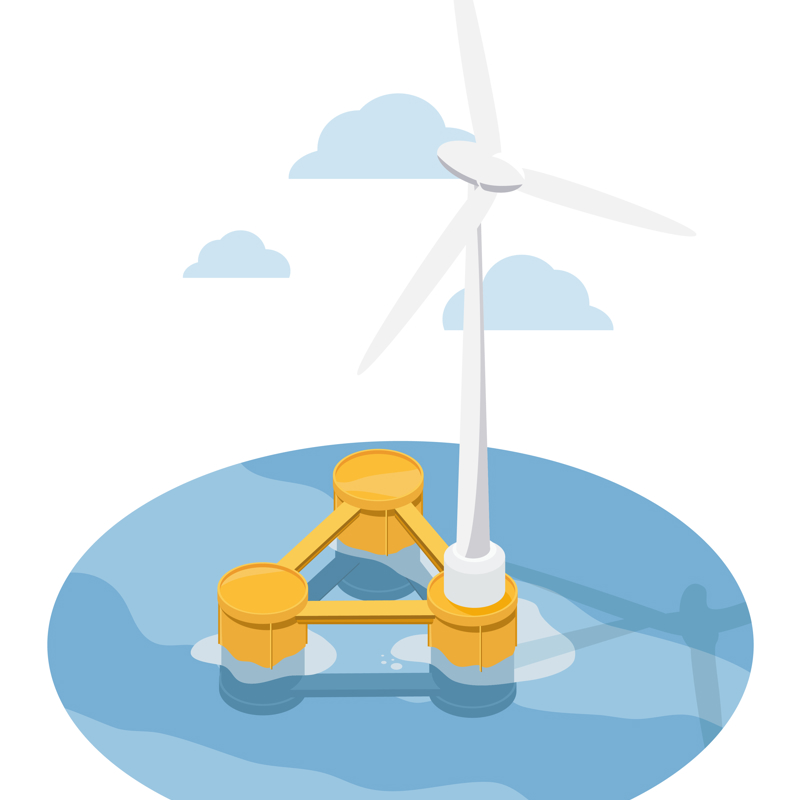
While floating offshore wind is still about three times the Levelized Cost of Energy (LCOE) on fixed bottom turbines, floating offshore wind has certain cost advantages.
The technology requires fewer operations at sea. Developers can pre-commission and assemble floating turbines onshore at a nearby port then tow the entire unit to the offshore farm site, meaning the assembly takes place in a much safer and more controlled environment.
The installation process is less dependent on weather, soil and sea conditions, which have the potential to cause lengthy and costly delays.
Then once at sea, operators have the option to tow back the turbines to port for large maintenance operations like blade replacement.
There are a few challenges that face those considering floating offshore wind. The technology is newer and less tested or known at a commercial scale. There are also numerous designs to choose from, which is not always a positive.
Issues also arise with the movement of floating structures, like the cables and mooring lines, and to allow for this it is anticipated projects will require larger exclusion zones.
Port access, size and accessibility will prove challenging. Because floating turbines can be assembled and undergo maintenance on land, it means ports will need to have a greater capacity for service and assembly. Ports will also need to be in a protected harbour to enable final assembly and tow-out of turbines. And channels will need to be deep given the floating turbines will likely be wider than most cargo vessels.
Skills shortages can be added to the list too, but that is a challenge shared by all potential offshore wind farms in the region.
For floating offshore wind to be a feasible option here, we need to create the right environment for success.
For Australia to compete on a global scale and attract international as well as local investment, there must be clear signals of support and certainty from government. This includes a clear route to market to support business case development and investment confidence, funding for public and private research and innovation partnerships, and support for demonstrator or pilot projects in the region to test local conditions. There also needs to be more feasibility studies and funding made available for technology development so as to determine the optimum technology for the environmental conditions we have in Australia.
There is good reason floating offshore wind is gaining momentum. Let’s hope there are willing parties with an appetite to embrace and invest in floating technology in Australia.
________
* This article is a summary of a masterclass presentation from Elevate - RPS’ internal offshore wind training program. More than 80 RPS consultants have taken part in the course designed to meet client demand for offshore wind specialists. The program is also offered to RPS’ offshore clients.
No Content Set
Exception:
Website.Models.ViewModels.Blocks.PageBlocks.CardBlocks.KeyContactsCardBlockVm